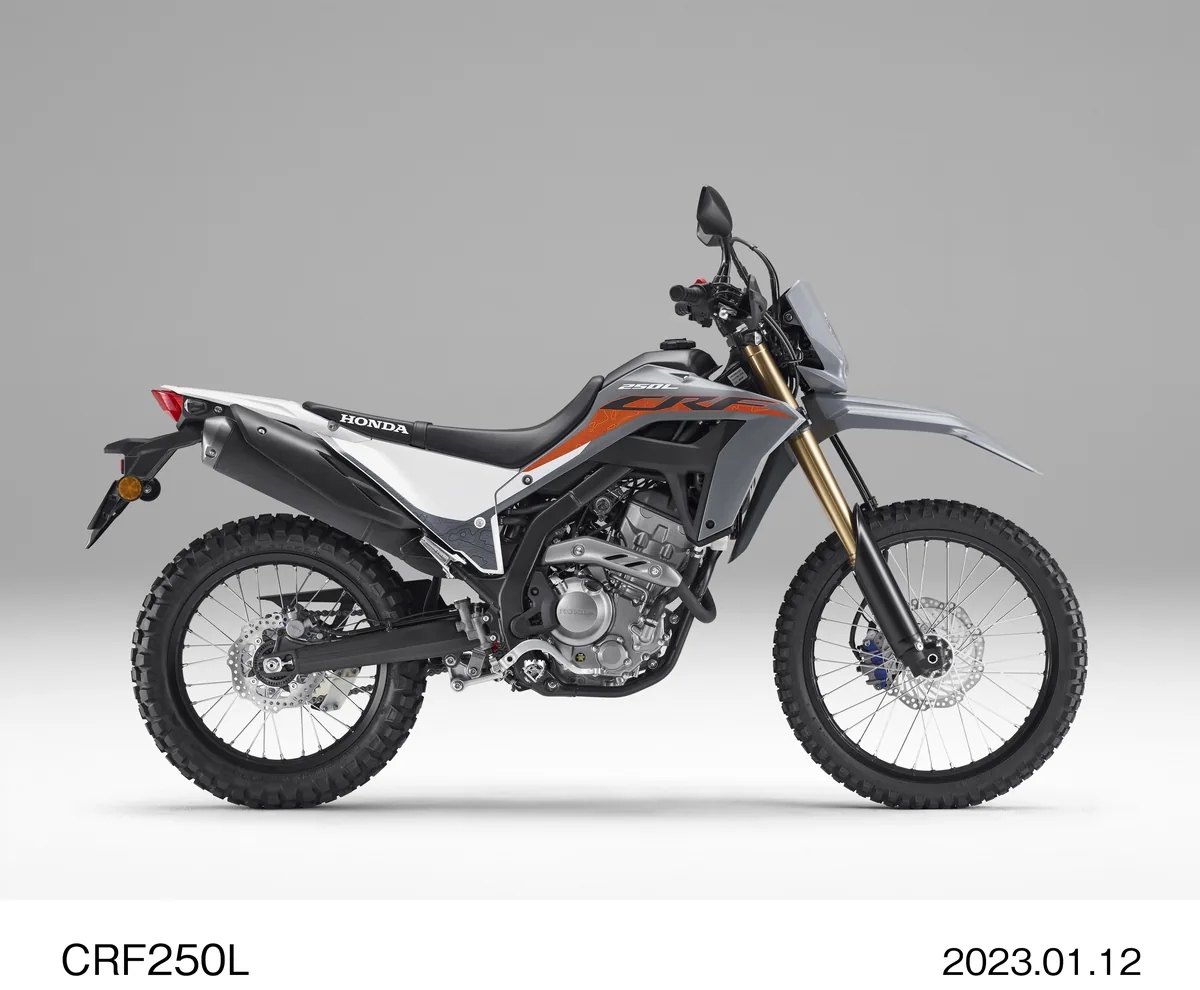
Data sheet
Dimensions & weights
- Wet weight
- 140 kg
- Wheelbase
- 1453 mm
- Suspension travel
- 300 / 290 mm
- Payload capacity
- 125 kg
Engine & drivetrain
- Engine
- Single
- Cooling
- Liquid cooled
- Final drive
- Chain
- Fuelling
- Electronic fuel injection
Fuel & range
- Fuel capacity
- 7.8 L
Electronics & rider aids
- Ride modes
- None
- Cruise control
- No
- Traction control
- No
- ABS
- Yes
- Heated grips
- No
- Heated seat
- No
Service intervals
- Chain lube
- every 1,000 km
Protection
- Bash plate
- None
- Radiator guard
- No
- Oil cooler guard
- No
- Hand guards
- Yes
Consumables & service specs
Every value carries its source.
Tyres
- Front
- 80/100-21M/C 51PBias-ply, tube-type; recommended tyre IRC GP-21FHonda OM CRF250L (Indonesia 2023) · official
- Rear
- 120/80-18M/C 62PBias-ply, tube-type; recommended tyre IRC GP-22RHonda OM CRF250L (Indonesia 2023) · official
Tyre pressures
- Front — solo
- 150 kPa= 1.50 kgf/cm² = 22 psi; cold tyre, solo riderHonda OM CRF250L (Indonesia 2023) · official
- Rear — solo
- 150 kPa= 1.50 kgf/cm² = 22 psi; cold tyre, solo riderHonda OM CRF250L (Indonesia 2023) · official
- Front — loaded
- 150 kPa= 22 psi; unchanged from solo-rider front pressure per manual, rider + passengerHonda OM CRF250L (Indonesia 2023) · official
- Rear — loaded
- 175 kPa= 1.75 kgf/cm² = 25 psi; cold tyre, rider + passengerHonda OM CRF250L (Indonesia 2023) · official
Engine oil
- Viscosity
- SAE 10W-30Honda 4-stroke motorcycle oil, API Service SG or higher (excluding oils labeled 'Energy Conserving'/'Resource Conserving'), meeting JASO T 903 standard MBHonda OM CRF250L (Indonesia 2023) · official
- Capacity
- 1.45 lAfter drain and oil filter change; 1.35L after oil-only change (no filter); 1.75L after full engine disassembly/rebuildHonda OM CRF250L (Indonesia 2023) · official
Coolant
- Type
- Honda Pre-Mix CoolantManual specifies use of Honda's own pre-mixed coolant product; no separate generic coolant spec/type code given beyond this product nameHonda OM CRF250L (Indonesia 2023) · official
- Capacity
- 0.86 lTotal cooling system capacity per manualHonda OM CRF250L (Indonesia 2023) · official
Brakes
- Fluid type
- Honda Brake Fluid DOT 3 or DOT 4Honda OM CRF250L (Indonesia 2023) · official
Final drive
- Chain
- DID 520VF, 106 links; front sprocket 14T, rear sprocket 40TChain slack (free play) spec: 50-55mm for CRF250L/CRF300L; recommended lubricant is an O-ring-specific chain lube, or SAE 80/90 gear oil if unavailableHonda OM CRF250L (Indonesia 2023) · official
Spark plugs
- Type
- NGK SIMR8A9Standard plug; gap is listed as fixed/not adjustableHonda OM CRF250L (Indonesia 2023) · official
- Gap
- 0.8-0.9 mmManual lists this range but notes the plug is not field-adjustable (fixed-gap design)Honda OM CRF250L (Indonesia 2023) · official
- Quantity
- 1Single-cylinder engineHonda OM CRF250L (Indonesia 2023) · official
Battery
- Type
- YTZ8V, 12V-7.0Ah (10HR), sealed/maintenance-free typeHonda OM CRF250L (Indonesia 2023) · official
Fuel
- Minimum octane
- RON 90+ (Indonesia/Philippines spec)Manual specifies unleaded gasoline, RON 90 or higher, for the IN/PH-spec CRF250L/CRF300L; the Thailand-spec CRF300LD sold in the same regional manual recommends RON 91+ insteadHonda OM CRF250L (Indonesia 2023) · official
- Ethanol tolerance
- Up to E10 (max. 10% ethanol by volume)IN/PH-spec limit per manual; Thailand-spec CRF300LD in the same manual tolerates up to E20Honda OM CRF250L (Indonesia 2023) · official
What breaks first and where.
Right-side crankcase cover oil leak / spray due to paint contamination in sealing plug bore (NHTSA 23V-261 / Honda Japan recall)
SeriousRareDue to an improper production sequence at the crankcase cover supplier, paint was misapplied to the inner surface of the press-fit sealing plug hole on the right-side engine crankcase cover. When engine temperature rises, the paint can soften, allowing the sealing plug to work loose and come out of its hole. This can cause engine oil to leak or spray onto the exhaust pipe and/or rear tyre while riding, creating a burn, fire, or crash/fall risk. Honda Japan's recall (announced April 5, 2023) explicitly lists the CRF250L (model code MD47, shared with CRF250 RALLY) among four affected models, with 594 CRF250L/CRF250 RALLY units built between May 20, 2022 and October 22, 2022 (i.e., part of MY2023 production) affected in Japan. A related but separately-numbered NHTSA recall (23V-261, filed by American Honda April 12, 2023) covers the same defect for the US-market 2023 Rebel 300, and Transport Canada's 2023215 recall covers the same defect for 2023 CB300R/CMX300 — confirming the crankcase-cover defect is a shared-platform quality issue across this small-bore engine family for MY2023 production, though the CRF250L itself was only sold (and thus only recalled) in non-US markets that year.
Symptoms
- Engine oil spraying or leaking from the right-side crankcase cover area
- Oil visible on the exhaust pipe
- Oil visible on/adhering to the rear tyre
Field repairableNo — Remedy requires dealer replacement of the right-side crankcase cover with a non-defective part; not a rider-serviceable field repair. Honda Japan notified dealers April 6, 2023 and began notifying registered owners by direct mail shortly after, replacing the cover once replacement parts were available.
Charging system failure — burned/shorted stator coil causing weak/no charging
ModerateOccasionalDocumented case (with full teardown diagnosis on video) of a CRF250L exhibiting a weak-cranking, no-start condition traced to a failed charging system: battery voltage measured near 10-11V (well below the expected ~14V running voltage), and after removing the left crankcase cover, two poles of the stator coil were found with visibly burned-out insulation, producing almost no AC output from the alternator. This is a generic small-single charging-system wear/failure mode seen across the CRF250L platform rather than a single-model-year-specific defect; included here as a documented community-reported failure mode rather than a factory recall.
Symptoms
- Weak or failed engine cranking
- Battery reads low voltage and won't hold a charge
- Dash/lights flicker or dim, especially under load
- AC output from alternator/stator measures far below expected voltage when tested
Field repairableYes — Diagnosed by testing battery voltage, then regulator/rectifier connector resistance and DC output, then AC output directly from the stator with the engine running; if stator AC output is abnormally low, the left crankcase cover must be removed to inspect/replace (or, as one owner did, manually rewind) the stator coil.
Front fork oil seal premature failure
ModerateCommonWidely reported community issue where front fork oil seals on the CRF250L fail and begin leaking prematurely, sometimes with fewer than 1,000-5,000 miles on the odometer, well before a seal would normally be expected to wear out. Not covered under warranty per owner reports. General platform-wide issue rather than confirmed as isolated to any specific model year.
Symptoms
- Visible oil weeping/leaking from fork tubes near the dust/oil seals
- Reduced fork damping performance
- Oil residue on lower fork legs
Typical failure point8,000 km
Field repairableYes — Fork seals can be replaced with basic tools (fork removal, seal driver, new seals and fork oil to spec); a common home/roadside mitigation is a fork seal 'wiper' cleaning tool to temporarily reduce leakage until proper seals can be replaced.
Chain adjuster bolts seizing in swingarm, leading to chain/sprocket/swingarm wear
MinorCommonCommunity-reported issue where the rear chain adjuster bolts corrode and seize inside the swingarm over time (commonly after 2+ years), making chain-slack adjustment difficult or impossible without penetrating oil/heat, and risking the adjuster snapping off. If chain slack subsequently goes unaddressed (especially when running a smaller front sprocket, e.g. 13T instead of stock 14T), the chain can run too loose and cut into the chain guide and swingarm.
Symptoms
- Chain adjuster bolts difficult or impossible to turn
- Uneven chain adjuster marks side-to-side, causing rear wheel misalignment
- In advanced cases, chain wear marks/cuts on the chain guide or swingarm
Field repairableYes — Preventive fix reported by owners: replace steel adjuster bolts with titanium equivalents and apply copper anti-seize/copper slip compound during installation to prevent future seizing.